

An electric vehicle (EV) is more expensive to buy than a gas-powered vehicle. But over the years, you save more on running your electric car than a gasoline vehicle. You can save more on operational costs by choosing to charge at home or at select public charging stations where you can avail of discounts. Additionally, many electric vehicles require less maintenance, as they have fewer moving parts compared to their gas-powered counterparts. This further contributes to the savings over time, making them a more economical choice for many drivers. For those considering the transition, this article serves as the ultimate guide to electric vehicle ownership, helping you navigate through the various options and benefits available.
You can pay for charging an electric car at home via your monthly energy bill. You can use the pay-as-you-go model or pay using ChargePoint or Blink at a public charger. Electrify America provides free charging to Porsche owners.
In this article, I’ll explain how you can pay for charging your EV, both at home and at public charging stations. I’ll also give you the low-down on the costs of charging your EV. Knowing that you can make significant savings on charging costs is a powerful incentive to increase EV absorption.
Paying for EV Charging
It’s less costly to charge your EV at home than at a public charging station. But if you’re on the go, you have to stop by a public charging station.
There are many ways to pay for EV charging at a public charging station. You can swipe your credit or debit card if you use the pay-as-you-go model. Paying using Blink or ChargePoint is more convenient than using cards. Blink Charging and ChargePoint membership plans offer discounts and turn out to be cheaper than paying with your debit or credit card.
I wrote a detailed article discussing the possibilities of using a credit card when making a Tesla down payment. Check it out!
Read on to find out how you can use Blink Charging or ChargePoint to pay for EV charging.
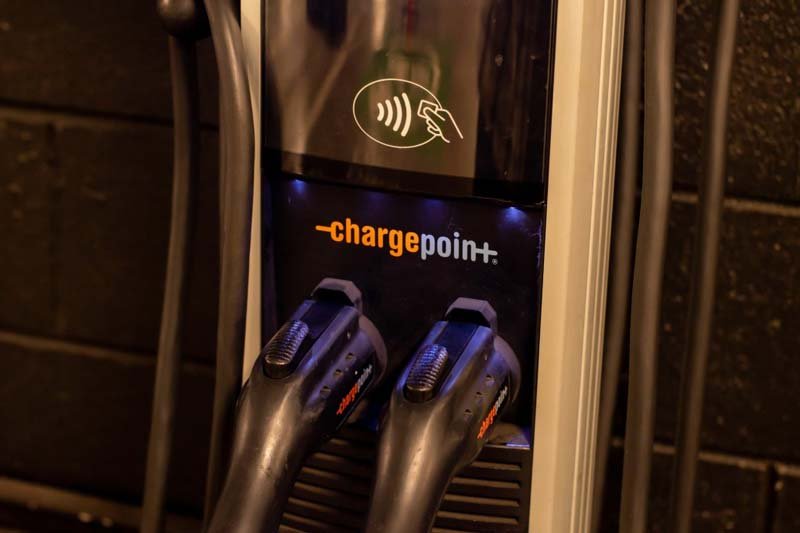
Photo @Dari via Twenty20
Do You Need an Account To Use ChargePoint?
You need an account to use ChargePoint and your iPhone or Android phone to make the payment. Tap to Charge is the easiest way to charge your EV at a ChargePoint station. You don’t have to carry your debit or credit card.
The Tap to Charge feature cannot be activated on all phones. If you use an iPhone, you need one that uses iOS 10 or a newer operating system, such as the iPhone SE, 6, 6 Plus, 6S, 6S Plus, 7, or 7 Plus. You can also activate Tap to Charge on Apple Watch Series 2, Series 1, and 1st generation.
The Tap to Charge feature works on Android 4.4 or newer systems with NFC.
The following are the steps of setting up your ChargePoint account to make Tap to Charge payments:
- Install the ChargePoint app if you don’t have it. The app is available for Android and iPhone.
- Sign up or log in to your account.
- If you’ve just created the account, add ChargePoint to your Apple Wallet or enable NFC on your Android phone.
- If you already have a ChargePoint account, open the menu in the top left corner.
- Select Account>Manage Cards>Set it up.
- Add ChargePoint Pass to your wallet or include it as a card. You’re now ready to use the Tap to Charge feature at any ChargePoint station.
And here’s how you can use the Tap to Charge feature at a charging station:
- Log into your ChargePoint account to use Tap to Charge.
- If you’re an Android user, turn on your screen and enable NFC.
- If you use the iPhone and its Touch ID feature, ensure your finger is on the home button.
- Hold your phone up to the scanner to unlock the connector.
- Plug in your vehicle to begin charging.
How Do You Pay for Blink Charging?
You can pay for Blink charging with your Blink member account. If you’re not a Blink member, you can pay using a one-time Blink Guest Code that you can buy from Blinkcode.com using a computer, mobile phone, or from the Blink mobile app. You can also contact Blink Customer Support at (888) 998.2546.
Blink memberships are free. As a Blink member, you receive discounts on charging prices at public charging stations that are part of the Blink network in the US. As a Pro member, you can also receive discounts on home charging and benefit from participating in giveaways.
As an added bonus to this article, I’ve created this easy-to-use charging calculator. Simply input your model, charging wattage, and charging percentage, and you will get the estimated time it will take to charge a Tesla in terms of hours. You can play around with numbers a bit just to see how charging time changes:
[stm-calc id=”6425″]
Using a Blink EV Charger
You can initiate a charging session at any public Blink charging station using your Blink Membership Card, a one-time Blink Guest Code, via the Blink Mobile app, or by contacting Blink Customer Support.
Follow these steps to use your Blink Mobile app to initiate charging:
- Use the Blink Mobile app to locate a Blink EV charging station.
- Sign in to your Blink account or continue as a Blink Guest.
- Enter your credit card details into the app to initiate payment for the charging session.
If you have a Blink membership account, you can initiate charging at a Blink station in the following way:
- Hold up your Blink membership card to the RFID scanner on the charger.
- Follow the instructions that appear on the screen.
Here’s how you can obtain a Blink Guest Code to begin a charging session:
- If you’re a Blink member but aren’t carrying your membership card, generate a Blink Guest Code by logging in to the membership site, via the Blink Mobile app, at Blinkcode.com, or by contacting Blink Customer Support. Then enter the code at any link charger by selecting Not a Member>Charge as a Blink Guest.
- If you’re not a Blink member, buy a Blink Code using your phone or computer.
How Much Does It Cost To Charge an EV in the US?
The cost to charge an EV in the US varies depending on where you plug your car, what charging system you use, and the fuel efficiency of your vehicle. The costs also vary if you charge your EV at home, Walmart, or a public charging station.
All EVs sport a sticker that specifies the number of kW-hours per 100 miles or kWh per 100 miles that the car can notch up. This number is the fuel efficiency of the vehicle. The more efficient the car, the less electricity it uses to run 100 miles. So, before you calculate the cost of charging your EV, you must know the fuel efficiency value of your car.
| Vehicle | Model Year | EPA-Rated Fuel Economy (in kWh per 100 miles or 160.93 km) |
| Hyundai Kona Electric | 2021 | 27 |
| Ford Mustang Mac-E | 2021 | 37 |
| Tesla Model 3 Standard Range | 2020 | 24 |
| Tesla Model 3 Standard Range Plus | 2020 | 24 |
| Tesla Model 3 Long Range AWD | 2020 | 28 |
| Hyundai Ioniq Electric | 2017 | 25 |
| Chevrolet Bolt EV | 2017 | 28 |
| BMW i3 | 2017 | 29 |
| Nissan Leaf | 2016 | 30 |
| Tesla Model S AWD-70D | 2015/2016 | 33 |
| Tesla Model S AWD-85D | 2015/2016 | 34 |
| Tesla Model S AWD-90D | 2015/2016 | 34 |
| Tesla Model S | 2014/2015/2016 | 35 |
| Tesla Model S AWD-P85D | 2015/2016 | 36 |
| Tesla Model S AWD-P90D | 2015/2016 | 36 |
| Tesla Model X AWD-90D | 2016 | 34 |
| Tesla Model X AWD-P90D | 2016 | 38 |
| Kia Soul EV | 2015/2016 | 32 |
| Volkswagen e-Golf | 2015/2016 | 29 |
| Fiat 500e | 2016 | 30 |
| Mercedes-Benz B-Class Electric Drive | 2014/2015/2016 | 40 |
| Honda Fit EV | 2013/2014 | 29 |
| Toyota RAV4 EV | 2012/2013/2014 | 44 |
Read on to find out how the costs of charging an EV differ.
How Much Does It Cost To Charge an EV at Home?
In the US, EV owners do 80% of the battery charging at home.
It can cost $30 to $60 a month to charge an EV at home. The exact cost depends on how many kilowatt-hours (kWh) you consume and what your utility provider charges you for every kWh.
The national average cost of electricity is 13 cents per kWh. Most EVs travel at around four miles (6.44 km) per kWh. If your car travels 1,000 miles (1609.34 km) a month, it needs a minimum of 250 kWh for one charge. This means that charging your car at home will cost you $32.50 per month. Additionally, this monthly charging expense can be significantly lower than the fuel costs associated with traditional gasoline vehicles. When making a cost comparison of EV and gas, it becomes clear that electric cars offer substantial savings over time, especially given the current fluctuations in fuel prices. Overall, the reduced operational costs combined with potential government incentives make owning an EV an increasingly attractive option for many drivers.
According to the Environmental Protection Agency (EPA), electricity is cheap in states like Louisiana, Arkansas, Missouri, and Oklahoma. The average electricity rate here is $0.098 per kWh.
At an average rate of $0.331 per kWh, Hawaii and California pay some of the highest charges for electricity in the country. Depending on which state you live in, you might incur some of the country’s highest or lowest costs for running your EV. This disparity in electricity prices can significantly impact the overall expenses associated with electric vehicle (EV) ownership. In states with higher rates, the total cost of charging can lead to concerns about why electrify America costs more when compared to traditional gasoline-powered vehicles. Additionally, local policies and incentives designed to promote EV adoption may also vary, further influencing the overall financial landscape for electric vehicle owners.
Charging an EV at home can involve some upfront, one-time costs as well.
Cost of Installing Level 1 Charging Unit
Replenishing your EV battery using a 110-volt charging unit is known as Level 1 charging.
Considering that you have a garage or have access to the power grid, you may have to buy a basic 110-volt charging unit that will connect to a standard electrical outlet through a three-prong plug.
Some EV manufacturers provide this charging unit free with their cars. It takes about 8-24 hours to charge an EV fully with this method.
Cost of Installing Level 2 Charging Unit
Charging your EV battery using a 24-volt line is known as Level 2 charging.
You have to pay $240-$400 to have an electrician set up a 240-volt line in your garage. Additionally, you have to buy an external Level 2 charging system called the electric vehicle service equipment (EVSE). An EVSE can cost between $300 and $1,200. These are available as plug-in, hard-wired types. A wall-mounted unit that saves space can cost $300-$600 more to be installed.
Purchasing and installing a Level 2 charging unit for your EV sounds costly. But on the plus side, you can charge a completely drained EV battery in as little as four hours with this unit. Some states and local governments also provide incentives for the cost of buying and installing a charger.
How Much Does It Cost To Charge an EV at a Public Charging Station?
Most public EV charging stations use Level 2 units. Only a few stations use Level 3 charging units. The prices are set based on the kWh of electricity used or the number of minutes charged. Some Level 2 charging stations offer free battery charges, but there aren’t too many such providers.
The cost to charge an EV at a public charging station differs between providers and across states. Blink Level 2 stations charge $.04-$0.06 per minute, while ChargePoint allows property owners to set the rates. Charging at an EVgo Level 3 station can cost about $0.29 per minute in the Chicago area.
Level 2 Public Charging
Level 2 public charging stations are common across the US. They’re located in retail parking lots, new-car dealerships, and public parking garages. These charging stations are strewn all over a large city or a bustling college town in regions with a high concentration of EVs.

I researched How Much Charge Electric Cars Lose in Cold Weather. Feel free to read the detailed article.
Level 3 Public Charging
Level 3 public charging stations are rarer to come across than the Level 2 ones. It’s quicker but costlier to charge your car at a Level 3 or DC Fast Charging (DCFC) station. You can charge 80% of your EV’s battery capacity in 30-60 minutes at one of these stations.
EVgo operates the largest network of Level 3 EV public charging stations in the US. It offers free charging for two years to BMW i3 and Nissan Leaf owners in select metropolitan areas.
Tesla owners can charge their cars at the fast-charging Supercharger stations run by Tesla Motors. However, these stations are only for Teslas. It costs an average of $0.28 per kWh to charge at a Supercharger station. If you’re charging at or below 60 kW, the cost of refueling your Tesla is $0.26 per minute. For charging above 60 kW, you have to pay $.13 per minute.
You can charge all makes of EVs at Electrify America’s charging stations. However, Porsche has partnered with Electrify America, and you can charge your Porsche vehicle free for 30 minutes (DC) or 60 minutes (AC) at these partner stations.
How Much Do You Have To Pay To Charge Your Car at Walmart?
You can charge your EV for free at the charging stations installed at Walmart’s parking lots. Every installation site has the standard 150 kW stations and the ultra-fast 350 kW stations. You can charge your car at a rate of 20 miles (32.19 km) per minute at the 350 kW stations.
Walmarts are usually located near highways. By providing free EV charging services, Walmart has made it possible and convenient for electric car owners to embark on cross-country road trips.
Walmart’s charging stations are primarily located in suburban and rural communities in states with low EV penetration. By providing free charging, the retail giant is incentivizing EV ownership in these regions.
Does Cold Weather Affect EV Charging?
Cold weather reduces EV battery performance and lessens its capacity to accept the charge. When the temperature falls to 20OF (-6.67OC), and you use the heater, EVs lose about 41% of their operating range. The battery starts to run low sooner, and it takes longer to charge an EV during cold months.
When charged at 77OF (-25OC), a DCFC charger takes about 30 minutes to charge an EV battery to 80%. At 32OF (0OC), the battery’s state-of-charge was only 44% after 30 minutes. It thus costs you more to charge an EV and keep it running during extreme cold.
High temperatures reduce the operating range of an EV if you use air conditioning.