

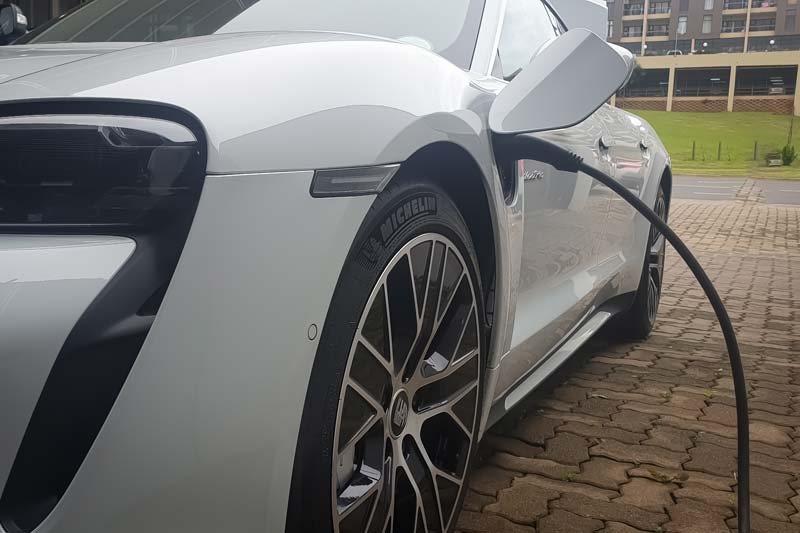
Porsche Taycan is the first all-electric car or battery-electric vehicle (BEV) of the German brand owned by the Volkswagen Group. Unlike a Tesla, the Porsche Taycan has two charging ports in the front, one on each side. So, why does a Porsche Taycan have two charging ports?
A Porsche Taycan has two charging ports to facilitate convenient charging at home and destinations. Both ports can use AC charging, so you can align a Porsche Taycan either way. But you can use only the passenger side port of a Porsche Taycan for DC charging.
The two charging ports of a Porsche Taycan are not identical. Also, you should never try to use both charging ports simultaneously, albeit one door shouldn’t open if the other isn’t closed. Read on to learn more about the two charging ports of a Porsche Taycan and what they imply.
Porsche Taycan Has Two Types of Charging Ports
The symmetrical positioning of the two charging ports on either side in the front of a Porsche Taycan doesn’t imply that they are identical. Here’s the most significant difference between the two charging ports:
- The driver-side charging port of a Porsche Taycan is an SAE J1772 AC socket.
- The passenger-side charging port is an SAE CCS Combo socket for both AC and DC.
Now, if you are in England or India, the driver’s side is on the right of a Porsche Taycan. And the front passenger side charging port is to the left.
In the United States and many other countries, including those in mainland Europe, the AC-only charging port is on the left, on the side of the driver. The CCS Combo socket that is compatible with both AC and DC is on the right, on the front passenger side.
The Porsche Taycan isn’t the only all-electric or battery-electric vehicle with two charging ports.
A few Audi e-Tron models, like the 2023 standard and S trims, have two charging ports, too. But the Audi e-Tron variants have an AC-only charging port on the passenger side. The charging port on the driver’s side is compatible with both AC and DC charging stations or power sources.
Audi’s e-Tron models featuring two charging ports aren’t surprising since the brand is also owned by the Volkswagen Group, like Porsche. That said, neither the Audi e-Tron nor the Porsche Taycan offers simultaneous dual charging.
This configuration of two charging ports has nothing to do with the kind of dual charging patent filed by General Motors. GM plans to use batteries in parallel and series for charging an electric vehicle with two different power sources simultaneously.
The Porsche Taycan’s SAE J1772 AC Socket’s Charging Specs
The driver-side charging port is an SAE J1772 AC socket that you can use with both 110 V to 120 V and 220 V to 240 V electrical circuits. This AC-only charging port facilitates up to 22 kW of power with an onboard adapter while using a 220 V or 240 V receptacle or wall outlet.
Here are the implications of the SAE J1772 AC port’s charging specs for your Porsche Taycan:
- A 120 V power source delivering 15 to 20 amps can deliver 1.8 kW to 2.4 kW of power to a Porsche Taycan through the SAE J1772 AC socket on the driver side.
- A 240 V power source delivering ~40 amps can provide 9.6 kW of power to a Porsche Taycan using the AC-only charging port.
- Porsche Taycans include a NEMA 14-50 plug for level 2 or type 2 charging. If a 220 V or 240 V receptacle or wall outlet at your home or a destination charger can deliver up to 50 amps, your Porsche Taycan can draw around 10 to 11 kW of power, respectively.
- Thus, a Porsche Taycan’s Performance Battery with a capacity of 79.2 kWh will take up to 8 hours to go from 0% to full state of charge using a level 2 or type 2 power outlet.
- The Performance Battery Plus in a Porsche Taycan that has a capacity of 93.4 kWh will need up to 10 hours if a home or destination AC power source delivers close to 50 amps at 220 V or 240 V.
By the way, if you’d like to find out if a Porsche Taycan’s Battery Can Be Upgraded, then check out this related article that I wrote.
The current flow is rarely 50 amps, even if you use a NEMA 14-50 or 6-50 plug. The net amps are likely to be less, somewhere around 35 to 40.
It is also futile to set up a greater capacity because a Porsche Taycan is unlikely to draw over 40 amps using a 220 V or 240 V AC source unless you have the optional onboard adapter to raise the cap to 22 kW.
The SAE J1772 charging port on the driver’s side, or on the left in the front section in the US, isn’t compatible with a DC power source. So, you cannot use this port at any fast or rapid charging stations, such as those of Electrify America.
The Porsche Taycan’s SAE CCS Combo Socket’s Charging Specs
The SAE CCS Combo socket on a Porsche Taycan to the front passenger side on the right in the US has 5 pins for an AC power source, like the J1772 charging port. Plus, this port can facilitate fast DC charging through 2 extra pins that are normally covered by a flap.
Here’s how fast an SAE CCS Combo socket can charge your Porsche Taycan using DC power:
- The SAE CCS Combo Socket or the passenger-side charging port of a Porsche Taycan can facilitate the transfer of a maximum of 350 kW of DC power at fast charging stations.
- However, a Porsche Taycan with a Performance Battery can draw a maximum of 225 kW of power even at a DC fast charging station. So, the Performance Battery should take a tad less than half an hour to go from 0% to 80% charge using this DC port.
- The Performance Battery Plus can draw up to 270 kW of power from a DC fast charging station through the SAE CCS Combo port. You can expect this battery to go from 5% to 80% state of charge in 22.5 minutes at an 800 V DC fast charging station.
You might be wondering, now why Porsche didn’t just go with one CCS Combo socket that you can use for both AC and DC power sources. Surely, one combo AC & DC charging port could have facilitated a current flow or power transfer for all available setups we have right now.
Porsche reasons that the two charging ports are for maximum compatibility. But that reasoning isn’t entirely valid because a single combo charging port would have also ensured maximum compatibility. Thus, the answer probably is convenience and AC interoperability on both sides.
The reason is almost similar to why almost every all-electric car or battery-electric vehicle has a single charging port on the driver’s side. Companies like General Motors say that drivers want to be aware of a charging cable or connector plugged into the vehicle when they get to the car.
This perceived reason isn’t always practical, as many charging stations or destinations with the wall units are on the right side of parking lots, roads, and service lanes. Many all-electric vehicle owners toss the charging cable over their cars to get to the port on the driver’s side.
The only rationale in the case of the Porsche Taycan is the convenience factor of being able to align your car in any direction when you use an AC source at home, at a destination, or on the road.
The DC charging port is only on the passenger side of a Porsche Taycan. So, you don’t have a choice of this specific convenience at a fast charging station.
The other reason is probably contingency or redundancy. You are probably familiar with the two types of charging port doors Porsche Taycans have. One is the simple form factor that you press, and the charging port door opens outward. The other is a fancy variant with a sensor. You glide your hand for the charging port door to sense your gesture and open and retract inside.
Regardless of the alternatives and standard specs, having an extra charging port is definitely a failsafe option if one doesn’t work. Of course, there’s only one DC fast charging port, so that is not in the equation when I talk about contingency or redundancy.
Does Every Porsche Taycan Model Have Two Charging Ports?
Every Porsche Taycan model has two charging ports. However, the different models or trims of the Porsche Taycan don’t have the same battery capacity. Thus, the charging speed will vary depending on the Performance Battery or Performance Battery Plus’ amps draw.
Here are the 10 Porsche Taycan models available now and their included battery pack for a standard purchase:
| Porsche Taycan Model | Standard Battery (Included) |
| Taycan | Performance Battery – 79.2 kWh1 |
| Taycan 4S | Performance Battery – 79.2 kWh |
| Taycan Cross Turismo | Performance Battery Plus – 93.4 kWh2 |
| Taycan 4 Cross Turismo | Performance Battery Plus – 93.4 kWh |
| Taycan 4S Cross Turismo | Performance Battery Plus – 93.4 kWh |
| Taycan GTS | Performance Battery Plus – 93.4 kWh |
| Taycan GTS Sport Turismo | Performance Battery Plus – 93.4 kWh |
| Taycan Turbo | Performance Battery Plus – 93.4 kWh |
| Taycan Turbo Cross Turismo | Performance Battery Plus – 93.4 kWh |
| Taycan Turbo S | Performance Battery Plus – 93.4 kWh |
The Performance Battery Plus gets charged faster at DC charging stations. But both the battery packs are likely to perform almost identically when you use an AC power source, whether it is a level 1 or type 2. The amps drawn by both these batteries from such outlets are the same.
Can I Use Both Charging Ports of a Taycan at the Same Time?
You cannot and shouldn’t try to use both the charging ports of a Porsche Taycan at the same time. Porsche explicitly warns against doing this in the manual. Also, the Porsche Taycan won’t open the two charging port doors simultaneously, so you can’t use both.
You will hear the clicking sound of one charging port door closing or latching whenever the other open. This applies to both available mechanisms, whether you operate the port doors from the center control console panel or have the fancier sensor outside to detect the hand gesture.
Can I Charge a Porsche Taycan at a Tesla Supercharger?
You cannot charge a Porsche Taycan at a Tesla Supercharger in the US unless you use a CCS adapter. However, the Tesla V2 and V3 Superchargers in most parts of Europe have a CCS connector, so you can charge a Porsche Taycan at these fast charging stations.
Tesla Superchargers in America use a proprietary connector, neither CCS nor CHAdeMO. You can get a CCS adapter for a Porsche Taycan or a CHAdeMO connector for an older Nissan Leaf or other electric vehicles. CHAdeMO is on its way out. Even Nissan has abandoned it now.
Tesla may switch to CCS connectors for its Superchargers in the US, which will enable Porsche Taycans to conveniently use the network. Until then, you must find an Electrify America station, a destination charger, or use Porsche’s dealer network, among other available options.
The scenario is pleasantly different for European owners of the Porsche Taycan. Here is a video of a Porsche Taycan charging at a Tesla V2 Supercharger:
Like Electric Felix did in the video, starting the charging session via the app before plugging in the Tesla Supercharger connector simplifies the process for a Porsche Taycan. Electric Felix has also used a Tesla V3 Supercharger to charge the Porsche Taycan in the Netherlands.