

We all see Tesla fires on media outlets. On the rare and seldom chance that they occur, the news gets blown out of proportion (excuse the pun). But what exactly happens when a Tesla actually burns? Can Teslas explode?
Individual battery cells have the potential to explode but this will never cause the complete Tesla battery pack. Teslas have minimal risk of fires overall and are thus less likely to be subjected to any kinds of explosions. Rare cases of Tesla fires are always exaggerated in the media.
But why do Teslas even have fires and how often do they occur? How dangerous is it when the cells do catch fire and explode? Check out the rest of this article to find out.
The “E” in Elon Musk Might Stand for Explode
Elon Musk might be able to buy himself a quick trip to space, but he hasn’t purchased the superpower of being completely fireproof yet. (Maybe he can’t get past the boss level? Weird). In the recent years since Teslas first hit the streets, there have been a handful of incidents in which Tesla models have caught fire or exploded.
You’re probably thinking, well, any car can catch fire and explode. Why would this be a special issue for a Tesla? (Some of you might be ahead of me.) Teslas don’t run on gasoline, so any reports of flames and smoke with perhaps a loud bang might call into question the safety of their batteries and other parts.
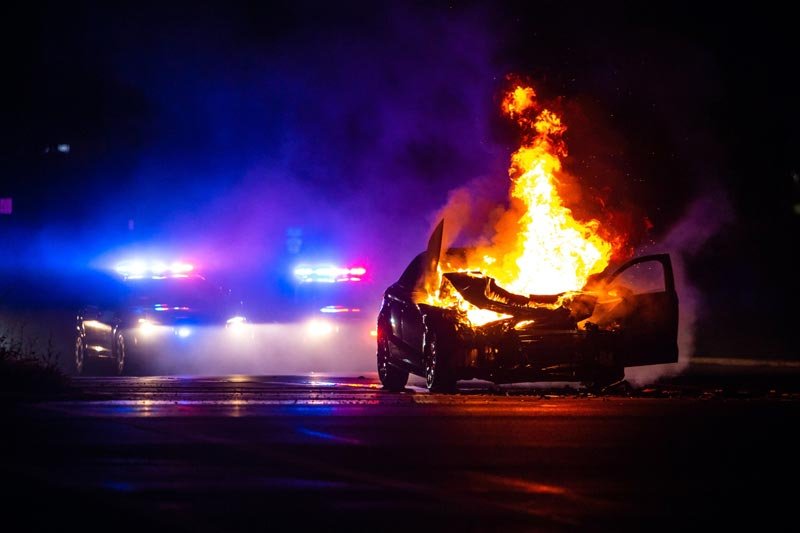
So, how does this happen? How worried should you be? Do Teslas explode often? You can relax, as it’s a pretty rare phenomenon. (If you happen to be reading this inside of a Tesla, you might want to take a minute and let your blood pressure return to normal. Sorry about that.)
Any electric vehicle is far less likely to blow up than those old gas cars of the stone age. However, Teslas have caught on fire and combusted. Here’s what you need to know.
Tesla Is on Fire! …Literally
If you perform a quick Google search, you’ll quickly realize that Teslas exploding has occasionally been a hot topic of debate on social media within the last couple of years. It first gained medium headway back in 2018 after a fatal car crash involving a Tesla was reported in popular news. Let’s take a close look at some of the reports, shall we?
Keep in mind that while all the examples below involve the Tesla Model S, nothing specifically about the Model S suggests they’re more prone to fires than other models –or different types of cars, for that matter. Vehicle fires, including the Model 3 and Model X, have also been reported.
2018: Fort Lauderdale, Florida: Tesla Model S
On Tuesday, May 8, 2018, there was a fatal car accident in Fort Lauderdale, Florida, involving a 2014 Tesla Model S. According to police, the vehicle was driving along the Seabreeze Boulevard highway when it suddenly veered off the road and crashed into a concrete barrier where it then immediately caught on fire.
Initial concerns regarding this tragic event were that the lithium-ion batteries used to power Teslas were unsafe and might be especially at risk for explosions or fires.
An investigation conducted by the National Transportation Safety Board determined that the cause of ignition in the battery was that the vehicle had been traveling 116 miles per hour upon impact with the wall.
Therefore Tesla’s battery was not at fault for causing the flames. The sheer force and heavy impact of a car weighing several tons against a wall can cause a fire regardless of the type of vehicle.
2018: Los Angeles, California: Tesla Model S
Later that same year, in June, reports of a Tesla that seemingly spontaneously combusted. The same model Tesla S was driving along a road in Los Angeles when the driver was alerted by pedestrians that his car appeared to be smoking heavily.
A spokesperson for Tesla commented on the incident, stating that the battery fire was incredibly unusual. Thanks to its specific battery design and placement, the car’s interior cabin was unaffected despite the fire.
2021: San Francisco, California: Tesla Model S
More recently, in 2021, a couple’s home in San Francisco was destroyed by a fire started by one of their two Teslas located in their downstairs garage. Tesla fell under scrutiny again for potential risks involving its battery technology. Although Tesla did not speak to the press directly about this incident, many electric vehicle companies, including Tesla, have warned drivers against leaving their cars to charge overnight or leaving them unsupervised.
Did You Know?
Car fires cause more damage than you might think. The National Fire Protection Association (NFPA) released a statement stating that in 2018 alone, vehicle blazes caused direct damage to property that totaled close to a whopping $2 billion.
However, modern technology improves the rate of explosions and car fires that happen yearly. Since 1980, the number of road flames has decreased by 60%.
Tesla Vehicle Safety
According to the 2021 Vehicle Safety Report published by Tesla, within the past decade, for every 210 million miles traveled by its vehicles and drivers, only one fire incident occurred. To put this in perspective, data collected by the NFPA in the United States has reported that statistics in cars overall reveal that for every 19 million miles traveled, there is one vehicle fire.
Random Tesla Stat:
In 2021,Tesla reported only one incident per 210 million miles traveled –a statistic that has only improved throughout the years. Here are Tesla’s vehicle fire reportings for the past four years:
| Year | Reported Incidents (per miles traveled) |
| 2021 | 1 for every 210 million miles |
| 2020 | 1 for every 205 million miles |
| 2019 | 1 for every 175 million miles |
| 2018 | 1 for every 170 million miles |
As you can conclude from the table, Tesla’s rate of vehicle fires is significantly lower than the national average.
Still, a clear trend of fire incidents becoming increasingly rare over the last four years. This proves that explosions and Teslas are not something to be concerned about and that their fire rates are decreasing every year.
On a somewhat similar note, check out this related article that I wrote called: “Is Tesla the Safest Car in the World?” I compared all Tesla models and thought it might give you further insight for this article.
What Causes Tesla Explosions
So, even though we’ve determined that bursting into flames is not something you should be worried about cruising around with your Autopilot on, you might still be wondering exactly how an electric vehicle can catch fire.
Lithium-Ion Battery Basics
Lithium-ion batteries power Teslas. This type of battery is favorable for their:
- Low weight
- Ability to be recharged
- High energy capacity
They’re found in countless items we use daily, including our cell phones, computers, tablets, and even our electric toothbrushes –so they’re considered safe.
Lithium-ion batteries pack a punch of energy in a relatively small size, generating charge by the movement of lithium ions. To understand more about how Tesla batteries can burst into flames, let’s look at the basic anatomy of a battery to figure out the process:
- Cathode: electrode with a negative charge in which electrons enter
- Anode: electrode with a positive charge in which electrons exit
- Electrolyte: the liquid solution contained inside that facilitates the movement of ions
- Separator: located in the center of the battery, this is where the electrolyte passes through to bring negatively charged ions from the cathode to the anode and vice versa.
Lithium ions held inside the cathode and the anode pass through the separator by the electrolyte, creating what’s called “free electrons” in the anode. This generates a positive charge that travels to the device it’s powering.
To learn more about how lithium-ion batteries work, check out this video:
Here Comes the Boom
There are three main reasons why a lithium-ion battery might explode and catch fire. The three “R” s: Rupture, Runaway, and Ridiculous combustion. I’m calling it ridiculous because there’s a one in one million chance of a lithium battery spontaneously combusting.
- Rupture: A lithium-ion battery can go up in flames when ruptured or penetrated somehow. If the battery’s interior is damaged, a shortage of electricity can occur. In a battery, positive and negative electrons flow has a specific route. In short, a sudden connection between two conductors along an unintended path has been formed. A short can cause a spark, and from there, highly reactive lithium takes it away for the blaze to begin.
- Runaway: In a process known as thermal runaway, if the battery’s temperature becomes hot enough, the chemicals inside can experience a chain reaction that generates even more heat and starts a fire.
- Ridiculous combustion: Again, one in one million!
Random Fun Fact:
Tesla makes the safest cars in the world. This rings true for their batteries. Indeed, the company takes pride in the top-tier engineering required to accomplish this. The reinforced structure surrounding the batteries makes them incredibly difficult to puncture. In the event of a fire, a unique safety mechanism within the Telsa isolates it from specific sections of the battery, and heat is vented out of the vehicle.